Croatia's property market is experiencing strong growth, with interest from both domestic and foreign buyers continuing to rise year on year. Apartments, houses, and villas along the coast, as well as in the countryside, attract those looking for a permanent home, a vacation retreat, or an investment property. But regardless of the type of property or location, one question always comes up: what does buying property in Croatia actually cost once you include all taxes and fees?
This guide gives you a clear, up-to-date answer, based on official sources from the Croatian Tax Administration.
Does Croatia Have Property Tax?
Croatia has several types of property-related taxes, and many buyers, particularly foreign ones, are not aware that there is more than one obligation to consider. Which taxes apply to you depends on whether you are buying, owning, or selling a property. The good news: if you are buying a new-build property, some of these obligations do not apply to you at all.
Key change from 2025: until the end of 2024, Croatia had a holiday home tax — an optional local tax that not all municipalities chose to introduce. From 1 January 2025, that tax was abolished and replaced by a mandatory annual property tax that all local authorities across Croatia are now required to implement. While many owners of second homes and vacation properties previously fell outside the tax system entirely, that is no longer the case.
This guide covers all relevant Croatia property taxes and costs for 2026:
- Real estate transfer tax — one-time tax on purchase
- VAT on new-build properties — instead of transfer tax
- Annual property tax — new obligation from 2025
- Rental income tax — for landlords
- Capital gains tax — when selling within two years
- Tax on inheritance and gifts — on property transfers
Croatia Property Transfer Tax Rate — 3% or 0%?
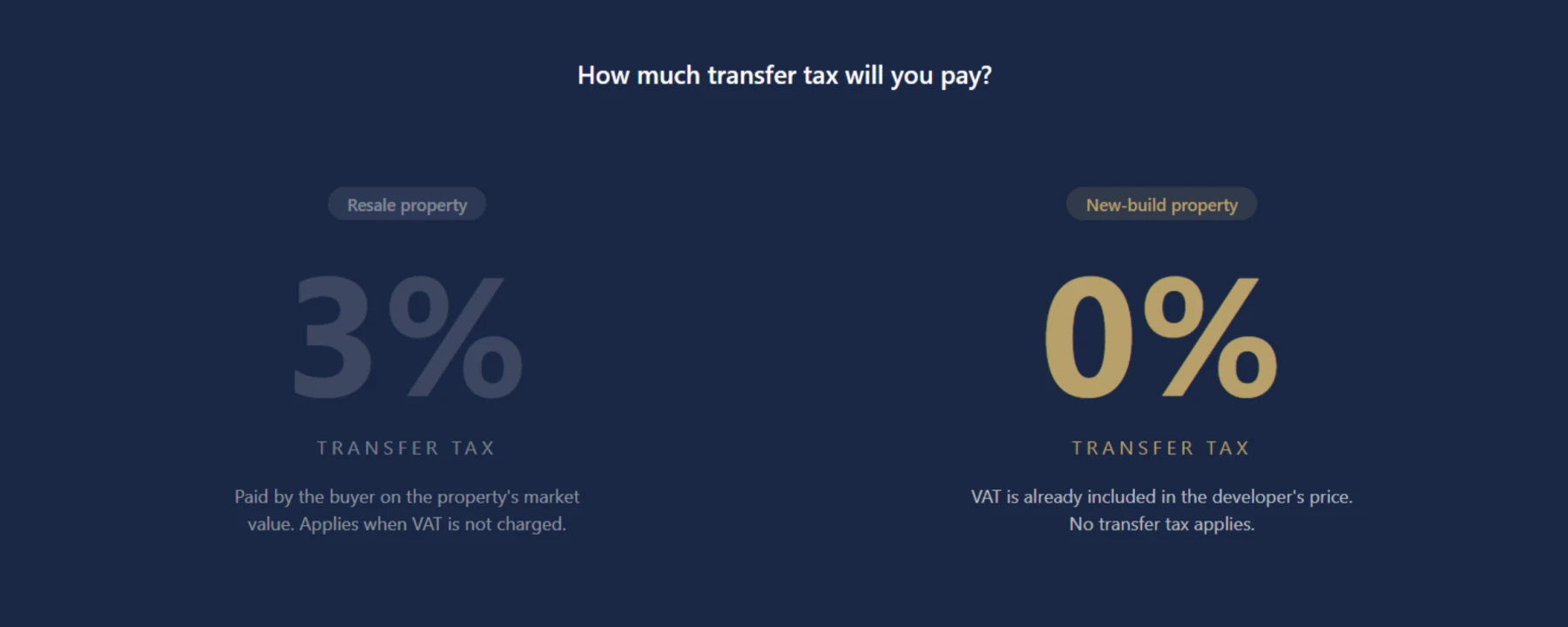
The real estate transfer tax is a one-time tax paid when purchasing a property, and one of the first costs buyers encounter. Under the Real Estate Transfer Tax Act, the tax is paid by the buyer, at a rate of 3% of the property's market value. The Tax Administration generally accepts the contract price as the basis, but has the right to carry out its own valuation if it considers the contract price does not reflect market value.
However, not all buyers pay this tax. It depends on what you are purchasing:
- Resale property — purchased from a private individual or a company not registered for VAT → 3% transfer tax applies.
- New-build property — purchased from a developer registered in the VAT system → no transfer tax.
The reason is straightforward: VAT and the real estate transfer tax are mutually exclusive — one or the other applies, never both. If you are buying a new-build property, VAT is already included in the price you pay to the developer. More on that in the next section.
Buying New-Build Property in Croatia? VAT Is Already Included
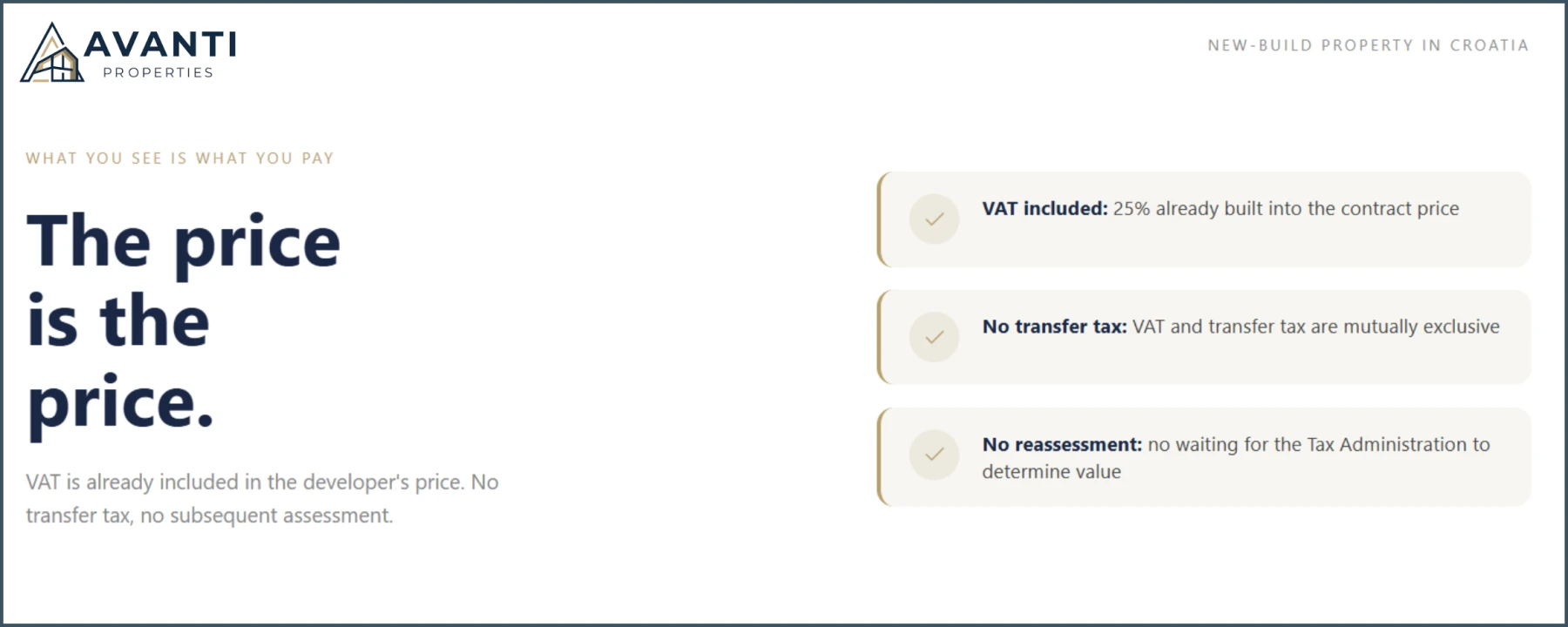
If you are buying a new-build property from a developer registered in the VAT system, you do not pay the real estate transfer tax. Instead, the transaction is subject to VAT at a rate of 25% — which is already included in the property price. In other words, the price stated in your contract with the developer already includes VAT, with no additional tax surprises at the point of purchase.
This is one of the key advantages of buying a new-build property compared to a resale, particularly for foreign buyers entering the Croatian property market for the first time. There is no subsequent tax assessment, no waiting for the Tax Administration to determine the value — the price is the price.
It is important to note that this rule applies exclusively to the first transfer of ownership of a newly built property. If a new-build is resold after having been in private ownership, VAT no longer applies and the standard 3% real estate transfer tax applies instead.
Annual Property Tax in Croatia From 2025 — What You Need to Know
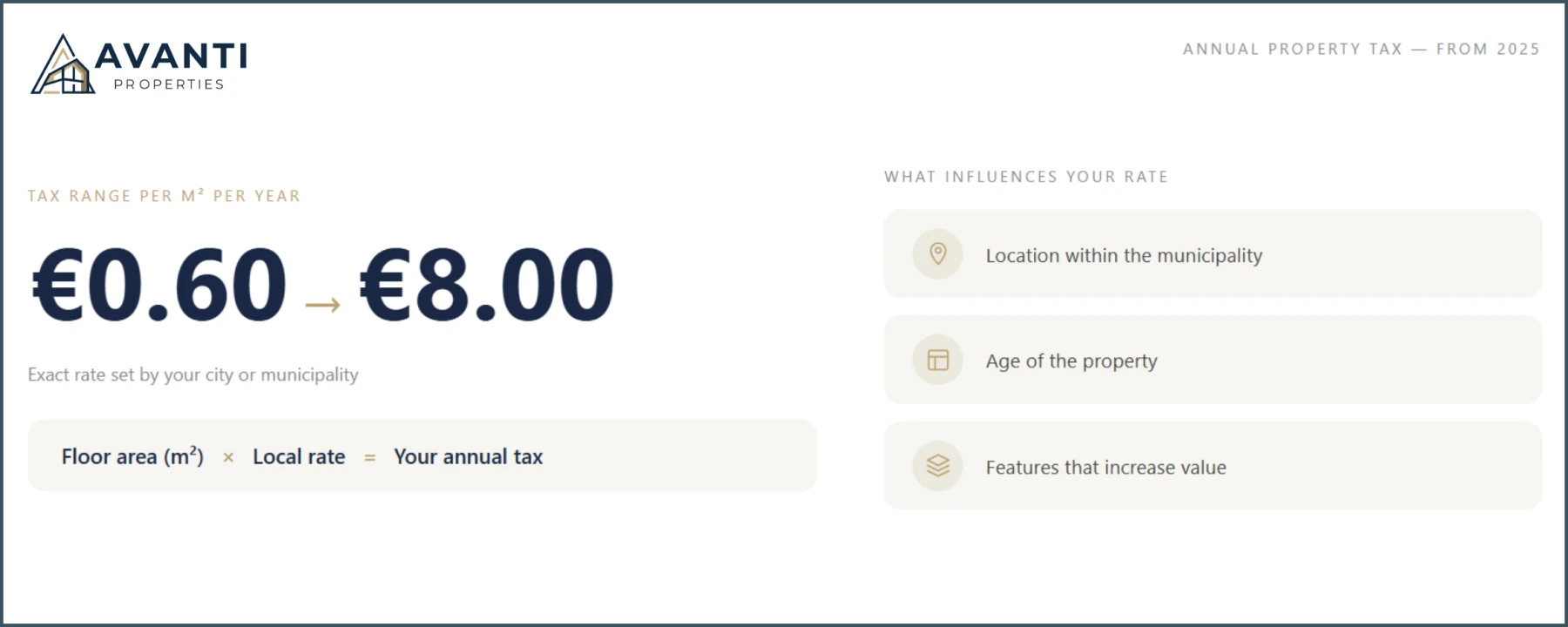
From 1 January 2025, Croatia introduced a new, mandatory annual property tax replacing the previous holiday home tax. According to the Croatian Tax Administration, the tax ranges from €0.60 to €8.00 per square metre of usable floor area per year, with the exact rate set by the city or municipality where the property is located.
This means the tax can vary significantly depending on location — tourist-popular coastal areas typically have higher rates than rural or inland areas.
Additional criteria can also influence the rate:
- Location within the municipality — zone, street or settlement.
- Age of the property — older properties may be subject to a different rate.
- Features that increase value — such as a swimming pool or sea view.
It is worth noting that the tax is not based on the market value of the property, but solely on floor area. This makes it a predictable cost that is easy to calculate in advance.
Who Is Exempt From Annual Croatia Property Tax?
Not every property owner in Croatia is automatically liable for this tax. Under the Local Taxes Act, there are clearly defined exemptions:
- Permanent residence — a property where the owner has registered permanent residence is not subject to the tax.
- Long-term rental — a property rented out under a residential lease agreement for a minimum period of 10 months is exempt. The agreement must be registered with the Tax Administration.
- Socially disadvantaged individuals — owners who meet the criteria set by the local authority.
For new-build buyers who plan to use the property as their primary place of residence, this is particularly relevant — in that case, you do not pay the annual property tax.
Renting Out Your Investment Property in Croatia — Tax Obligations
If you plan to rent out your property in Croatia, your tax obligations depend on whether you are renting it short-term or long-term.
- Short-term tourist rental: owners who rent their property to tourists can opt into a flat-rate tax system — a fixed annual amount per bed, determined by the local authority. This system is popular for its simplicity and predictable costs.
- Long-term rental: income from long-term rentals is taxed at a rate of 12% on net income (income minus allowable expenses). The rental agreement must be registered with the Tax Administration.
Bonus: a property rented out long-term (for a minimum of 10 months) also qualifies for an exemption from the annual property tax — an additional financial advantage for owners who choose this model.

Selling Your Property? Capital Gains Tax in Croatia Explained
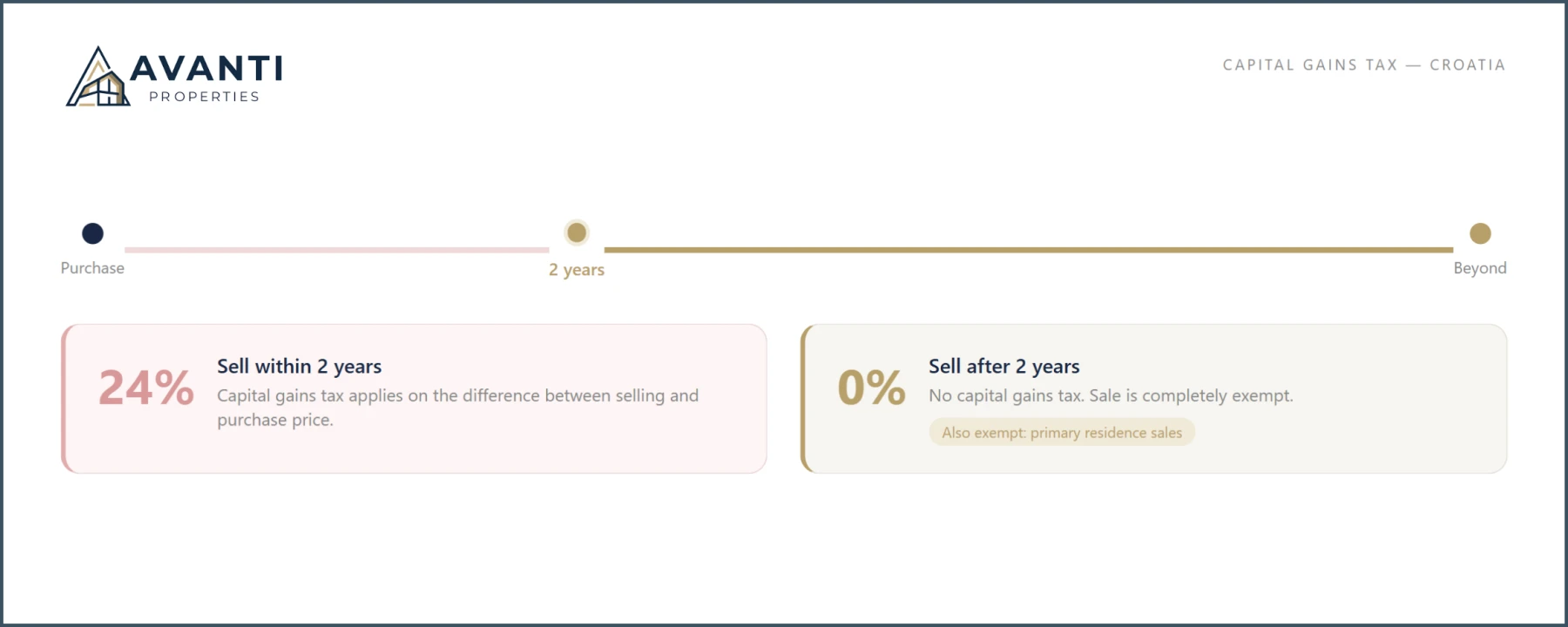
If you are selling a property in Croatia, capital gains tax applies in one scenario only — if you sell the property within 2 years of purchase. The rate is 24% on the difference between the selling price and the purchase price, plus any applicable surtax.
Who is exempt?
- Owners selling after 2 years — if you have owned the property for more than two years, you do not pay capital gains tax.
- Owners selling their primary residence — if the property was your first and only place of residence, you are also exempt, even within the two-year period.
For investors planning to hold the property long-term, this is particularly favourable — selling after two years is completely exempt from capital gains tax.
One exception applies to renovated properties: if a property has been substantially rebuilt or changed in use, the two-year period runs from the date it was made ready for use, not the original purchase date.
Property Transfer Tax on Inheritance and Gifts in Croatia
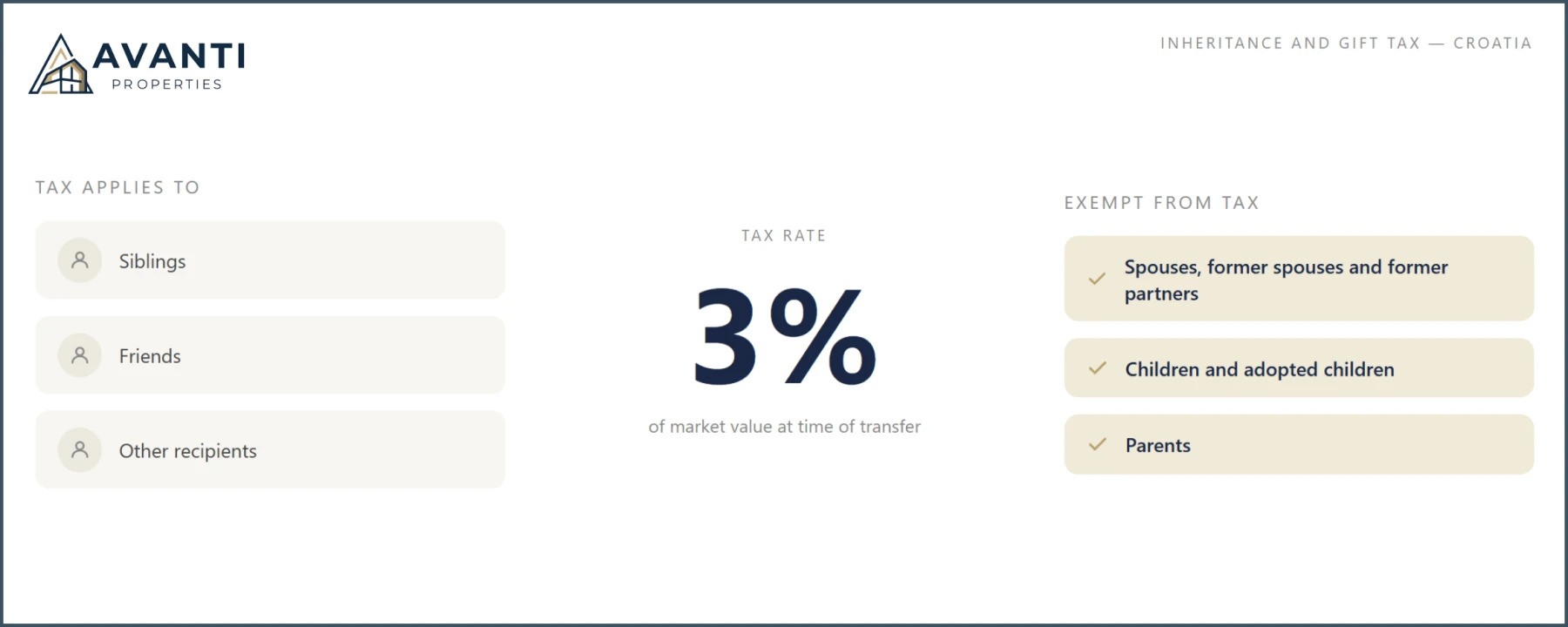
If you are not purchasing a property but inheriting it or receiving it as a gift, different rules apply. Under the Real Estate Transfer Tax Act, heirs and gift recipients pay 3% of the market value of the property at the time the tax liability arises.
Who is exempt from property transfer tax on inheritance and gifts? There are clearly defined exemptions:
- Spouses and former spouses — the transfer of property between spouses is exempt from tax, including when settling property relations after separation.
- Children and adopted children — direct descendants are not liable for the tax.
- Parents — the transfer of property between parents and children in either direction is not subject to tax.
If you fall into one of these categories, you do not pay tax on the property transfer. For all other heirs or gift recipients, such as siblings or friends, the 3% rate applies.
Buying Property in Croatia as a Foreigner — What's Different?
Buying property in Croatia as a foreigner is possible and relatively straightforward, but there are certain differences depending on whether you are an EU citizen or not.
EU Citizens
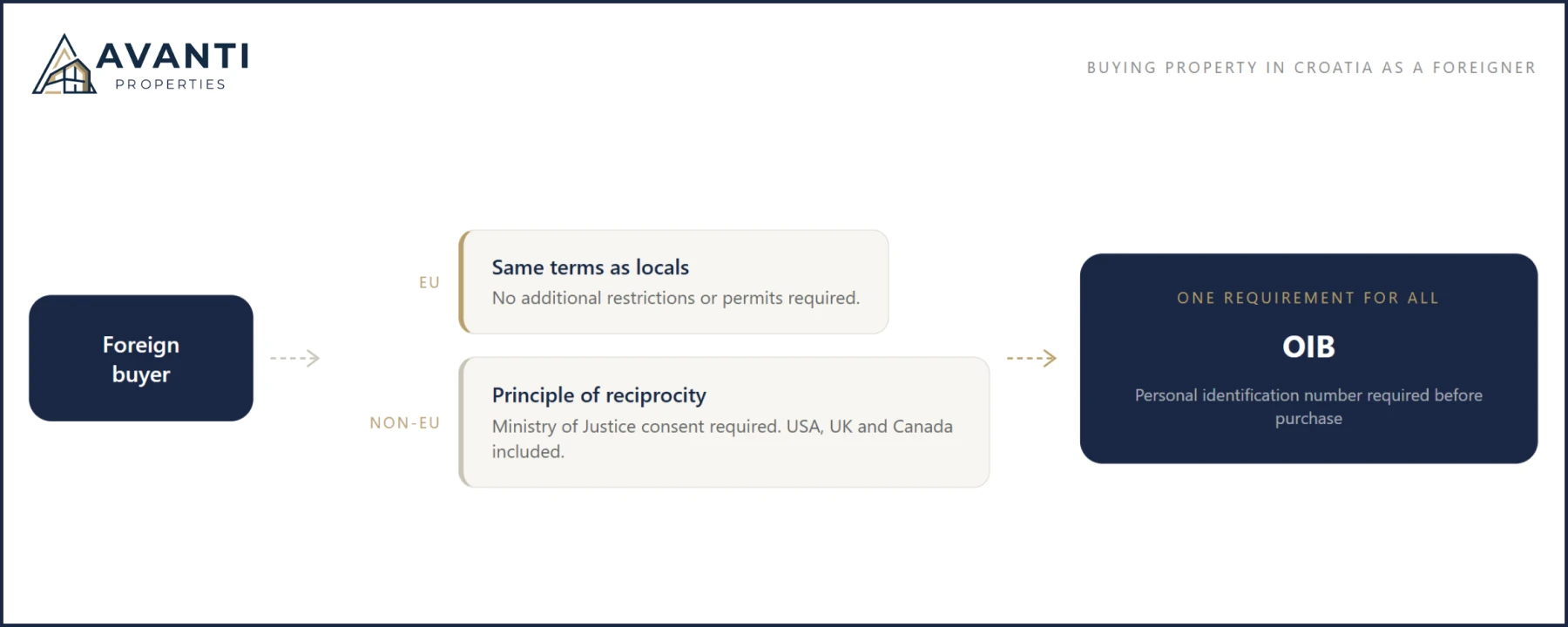
EU citizens can purchase property in Croatia under the same conditions as Croatian nationals — with no additional restrictions or permits required.
Non-EU Citizens
Buyers from outside the EU can purchase property in Croatia based on the principle of reciprocity — Croatia must have an agreement in place with your country. Most countries, including the USA, UK and Canada, have such agreements with Croatia. In this case, consent from the Ministry of Justice is required, which is a standard administrative procedure.
One Requirement That Applies to Everyone — OIB
Regardless of nationality, every foreign buyer must obtain an OIB (personal identification number) before purchasing a property. The OIB is a tax identification number required for all financial transactions in Croatia, including:
- Purchasing property
- Opening a bank account
- Filing taxes
The OIB can be obtained at any branch of the Tax Administration in Croatia.
Lawyer Fees, Notary, Agency — The Full Cost of Buying Property in Croatia
In addition to taxes, there are other costs to budget for when buying property in Croatia:
- Agency commission: around 3% of the purchase price.
- Notary fees: around €200–€800.
- Lawyer fees for buying property in Croatia: around 1% of the property value (plus VAT).
- Land registry fee: from around €30.
- Utility transfer fee: a minor administrative cost.
One way buyers can reduce the overall cost of purchase is by buying directly from the developer — no intermediary, no agency commission. On top of that, the developer prepares all necessary documentation in advance, making the entire process faster and more straightforward.
Buying Property in Croatia? Avanti Can Help
Understanding taxes and costs is just one part of buying property in Croatia. Equally important is finding the right partner to guide you through every step — from the first enquiry to receiving the keys.
Avanti Properties develops premium residential projects in Dalmatia — apartments and villas sold directly, with no intermediary and no agency commission. Every project is fully financed before ground breaks, with the same team leading the process from first sketch to final handover.
If you are considering buying a new-build property in Croatia, feel free to get in touch. We are happy to answer any questions about taxes, the buying process, and available projects. View our projects →